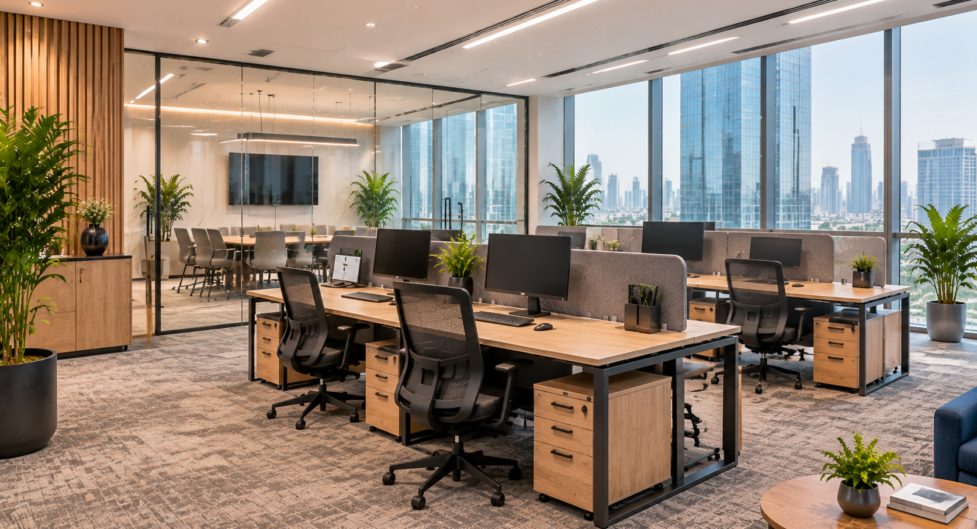

Scalable Office Furniture for Growing Teams is an important consideration for Dubai businesses preparing to hire more employees, expand departments, or reorganise their workplaces. The right furniture should accommodate today’s workforce while allowing practical changes as the company develops. Without a scalable plan, businesses may face crowded desks, insufficient storage, uncomfortable seating, and avoidable replacement costs.
Office expansion does not always require a bigger space or completely new furniture. Well-planned office workstations, compatible modular desks, ergonomic office chairs, adaptable meeting tables, and practical storage cabinets can help companies make better use of their available space.
At Furnicraft, businesses can explore office furniture solutions for modern Dubai workplaces, including modular workstations, executive desks, office chairs, meeting furniture, reception desks, storage and collaborative seating. This guide explains how to select furniture that supports business growth without sacrificing comfort, visual consistency or daily usability.
The Most Important Rule for a Growing Office
Choose furniture that can be expanded, moved, reused or combined with compatible pieces as your team changes. Start with a realistic headcount forecast, map the available floor space, and prioritise adaptable workstations, ergonomic seating, accessible storage and flexible meeting areas.
Scalability does not mean that every piece must be movable. Some furniture, such as executive desks and reception counters, can remain fixed. The goal is to identify which areas are most likely to change and select modular systems for those spaces.
Businesses can begin with the modular office furniture guide and use office space planning advice to evaluate their current layout.
Summary
Scalable Office Furniture for Growing Teams helps businesses respond to changing employee numbers, department structures and workplace requirements. Rather than replacing furniture whenever a company expands, scalable planning prioritises reusable, compatible and adaptable components.
The most important elements are modular workstations, supportive seating, suitable desk dimensions, flexible meeting tables, storage systems, privacy options and effective cable management.
Growing businesses should measure their premises, assess future hiring needs, compare furniture configurations and create an expansion plan before purchasing. A coordinated system can make future changes more manageable, although actual savings depend on furniture compatibility, installation requirements and the frequency of office reconfiguration.
This guide explores the main furniture types, layout strategies, budget considerations, expansion scenarios, common mistakes, expert recommendations and future workspace trends, together with relevant Furnicraft resources.
What Is Scalable Office Furniture?
Scalable office furniture refers to furniture and workspace systems that can accommodate changes in team size, layout or work activities without requiring a complete replacement of the existing setup.
Examples include modular workstation systems that can be expanded using compatible components, desks that can be rearranged into different team configurations, mobile storage units and tables that can support more than one meeting format.
Scalability depends on several characteristics:
- Compatibility with additional furniture components
- Practical reconfiguration and relocation
- Suitable dimensions for current and future layouts
- Durable construction for repeated use
- Flexible storage and technology integration
- Consistent finishes across later purchases
- Ability to support different team structures
For example, a growing operations department might begin with a four-person workstation cluster and later introduce an additional compatible unit. The process should preserve appropriate movement space, seating comfort and access to electrical connections.
Businesses should not assume that every product advertised as modular can be expanded indefinitely. Always confirm the manufacturer’s available configurations, component compatibility and installation requirements. Examples of office furniture configurations can be explored through the Furnicraft workstation category.
Why Scalable Furniture Matters for Dubai Businesses
Growing businesses often experience changes in employee numbers, team responsibilities, working schedules and client activity. Furniture that suited the original office may no longer meet operational requirements.
Changing team sizes
When new employees join, businesses need additional work surfaces, seating, storage and access to shared facilities. A flexible modular furniture system can make these changes easier to plan.
Department reorganisation
A company may divide an existing team into sales, operations and administration groups. Reconfigurable office workstations can support new seating arrangements, provided the space and supporting infrastructure allow it.
Hybrid working arrangements
Some teams may no longer require assigned desks for every employee. Shared workstations, suitable storage and adaptable collaboration furniture can help businesses use space according to actual attendance.
More efficient capital spending
Replacing complete furniture systems can create additional purchasing, installation and disposal costs. Furniture that can be reused may provide better long-term value, depending on its durability and the extent of future changes.
Consistent office appearance
A growing office should continue to feel coordinated. Selecting compatible furniture finishes and styles can prevent later purchases from creating a mismatched interior. Read office aesthetics and furniture design ideas for visual planning guidance.
Modular Furniture vs Fixed Office Furniture
Both modular and fixed furniture can work in professional offices. The best choice depends on how frequently a space will change.
| Factor | Modular Furniture | Fixed Furniture |
|---|---|---|
| Expansion | May allow additional compatible components | Often requires separate furniture purchases |
| Reconfiguration | Generally more adaptable when designed for it | May be difficult to move or rearrange |
| Installation | Can require planning for connectors and component compatibility | Usually planned around one established position |
| Visual Consistency | Can preserve matching finishes during expansion | May be harder to match after product ranges change |
| Best Application | Growing team areas and flexible collaboration spaces | Stable executive rooms and permanent reception installations |
| Long-Term Value | Depends on reuse, availability and durability | Can be suitable for stable, long-term layouts |
Businesses expecting substantial changes in staffing should give special attention to modular office furniture. Offices with stable leadership and reception areas may be better served by durable executive desks and appropriately selected reception desks.
Essential Scalable Office Furniture for Growing Teams
1. Expandable and Modular Office Workstations
Workstations are usually the foundation of a scalable employee area. They define seating capacity, circulation routes, desk access and the relationship between team members.
A well-planned office workstation system should provide enough working surface for each employee, comfortable chair movement and sufficient access to technology.
Useful characteristics include:
- Compatible workstation modules
- Practical desk dimensions
- Privacy panels where required
- Integrated or accessible cable management
- Suitable storage options
- Durable work surfaces
- Finishes that can be matched later
Furnicraft workstation examples include the Modular Office Workstation WS-46, Standard Office Workstation WS-16 and Linear Office Workstation WS-33. Each has a different configuration, so check current dimensions, specifications and suitability before ordering.
For workspace arrangement guidance, explore open versus private workstations and common workstation planning mistakes.
2. Ergonomic Chairs for Increasing Employee Numbers
As teams expand, chair selection should remain consistent in quality and suitability. Employees may spend significant portions of the day working at computers, making chair fit and adjustment important.
Suitable office chairs should provide appropriate seat dimensions, adjustable height, comfortable back support, stable construction and materials suitable for daily use.
Breathable mesh seating may be useful for teams seeking a contemporary design and improved airflow through the backrest.
However, one chair model will not necessarily fit every employee. Purchasing teams should consider different body sizes, adjustment ranges and available seating options.
Official OSHA computer workstation guidance explains how chairs, desks and other workstation components should support comfortable working positions.
Businesses can also review choosing ergonomic office furniture and important office chair features before increasing their seating inventory.
3. Flexible Desks for Different Roles
Growing companies do not need to give every role an identical desk. A better approach is to match desk design with daily work requirements while maintaining a consistent office appearance.
Operational employees may benefit from coordinated staff desks and workstation modules. Managers may require larger work surfaces or additional storage through manager desks. Senior leadership areas may use executive desks that support both individual work and visitor meetings.
Flexible desks should be assessed for:
- Available work surface
- Appropriate height and leg clearance
- Monitor and keyboard positioning
- Storage compatibility
- Cable access
- Ease of relocation
- Long-term durability
A desk should not be considered scalable simply because it is lightweight. True scalability also depends on whether it works with other furniture, can be integrated into future layouts and remains practical for the assigned task.
4. Meeting Tables That Support Changing Team Needs
As a business grows, the number and types of meetings may change. More departments may require collaboration spaces, interviews, team briefings, project reviews and client discussions.
A practical meeting table should suit the room dimensions and expected seating capacity. Businesses using rooms for multiple activities may benefit from movable or reconfigurable tables, provided the selected products support that use.
When evaluating meeting furniture, consider:
- Normal and maximum meeting attendance
- Table shape and available clearance
- Chair comfort
- Screen visibility
- Power and connectivity requirements
- Movement around the room
- Storage for meeting equipment
For additional guidance, explore meeting table buying recommendations, meeting table quality considerations and conference layout ideas.
5. Storage Systems That Can Grow with Departments
Storage is often underestimated when planning an office expansion. New employees may require places for personal items, documents, stationery and shared equipment.
Suitable office storage cabinets should be positioned near the teams that use them while preserving clear walkways.
Depending on operational needs, businesses may use:
- Shared storage cabinets
- Filing units
- Mobile pedestals
- Vertical storage systems
- Lockable cabinets
- Meeting room storage
- Reception storage
The storage and filing furniture category offers options worth reviewing when planning document organisation and additional employee capacity.
Storage should be treated as part of the layout, not as furniture purchased only after clutter becomes a problem.
6. Flexible Reception and Collaboration Furniture
Growth affects more than employee desks. Businesses may receive more visitors, hold additional meetings or require new spaces for informal collaboration.
A well-sized reception desk, suitable waiting seating and organised visitor flow can help the entrance remain functional as activity increases.
Companies should also consider collaborative area furniture, sofas and lounge seating for informal meetings.
For privacy-sensitive tasks, appropriate silent box solutions may help provide quieter areas without redesigning the entire workplace.
Read the reception desk planning guide to understand how visitor areas can remain practical and visually consistent.
How to Plan Office Furniture for the Next Stage of Growth
Choosing Scalable Office Furniture for Growing Teams should begin with a structured review of business requirements.
Step 1: Evaluate your current headcount
Record the number of employees who regularly work in the office. Separate assigned desks, shared desks, meeting needs and visitor requirements.
Do not assume every employee uses a desk simultaneously. Attendance patterns and job roles should influence capacity planning.
Step 2: Consider realistic hiring scenarios
Create practical scenarios for limited, moderate and substantial growth. Each scenario should identify the additional seating, storage and meeting facilities that may be required.
Planning several scenarios is more useful than choosing one optimistic hiring estimate and designing the entire office around it.
Step 3: Review available floor space
Measure work areas, doors, circulation routes, windows, columns, meeting spaces and storage zones. Furniture should leave sufficient room for employees to move and perform their work.
See office space optimisation guidance and office movement layout planning before deciding where to introduce new workstations.
Step 4: Choose compatible furniture systems
Ask whether the selected workstation components can be added to later. Confirm that matching finishes, screens, storage modules and desk components are available or can be sourced.
Product examples such as WS-46 modular workstations and WS-33 linear workstations provide configurations that businesses can compare against their floor plans.
Step 5: Plan infrastructure alongside furniture
Additional workstations may require power connections, network access, lighting changes or alterations to circulation. These requirements should be checked before furniture installation.
Step 6: Establish a phased purchasing plan
Purchase essential furniture for the current team while documenting what will be required during later expansion. This can reduce the risk of buying unnecessary pieces too early.
Example: Planning Growth from 12 to 20 Employees
Consider a hypothetical Dubai business with 12 employees that expects to grow to approximately 20. Its current office contains individual desks, a small meeting room, a reception counter and limited storage.
Instead of immediately replacing every desk, the company could evaluate whether compatible workstation modules could be introduced in stages.
| Planning Area | Current Team: 12 | Possible Team: 20 | Scalable Approach |
|---|---|---|---|
| Desks | 12 assigned seats | Up to 20 seats, depending on attendance | Plan compatible workstation expansion |
| Office Chairs | 12 task chairs | Additional suitable seating | Maintain ergonomic specifications and options |
| Storage | Limited shared cabinets | More personal and shared storage | Add coordinated cabinets where needed |
| Meetings | One small meeting room | Greater collaboration demand | Review scheduling, furniture and room capacity |
| Privacy | Existing quiet areas | Possible additional focus needs | Consider screens or suitable quiet zones |
| Infrastructure | Connections for current desks | Potential additional electrical and network needs | Review building and IT capacity before expansion |
This is an illustrative planning scenario, not a recommended occupancy calculation. Actual capacity depends on the building, room configuration, work activities, accessibility, safety requirements and applicable local regulations.
For related layout decisions, review open and private workstation comparisons and small office setup ideas.
Choosing Furniture for Different Stages of Business Growth
Companies at different stages require different furniture strategies. Matching purchases with realistic operational needs can help avoid unnecessary complexity.
| Growth Stage | Furniture Priority | Planning Objective |
|---|---|---|
| New or Small Team | Essential desks, ergonomic seating, basic storage | Establish comfortable daily operations |
| Early Expansion | Additional compatible workstation units | Increase employee capacity |
| Growing Departments | Workstation clusters, more storage, meeting furniture | Improve team organisation |
| Established Corporate Team | Coordinated management, reception and collaborative furniture | Support multiple workspace functions |
| Changing Work Patterns | Shared desks, flexible layouts, privacy solutions | Adapt space to actual attendance and tasks |
Businesses with stable executive rooms may choose durable leadership desks, while rapidly changing departments may benefit more from modular workstations.
How to Compare Long-Term Furniture Costs
The purchase price is only one part of office furniture cost. Businesses should also consider installation, maintenance, future additions, relocation and potential replacement.
A useful comparison examines the total expected cost of ownership over the planned period of use. The calculation can include:
- Initial furniture purchase
- Delivery and installation
- Required electrical or technology modifications
- Maintenance and repairs
- Future compatible furniture additions
- Relocation or reconfiguration
- Removal or replacement costs
For example, a slightly more expensive compatible workstation system may offer better value if it can be reused during several office changes. But this outcome depends on actual reconfiguration costs and the availability of compatible components.
Businesses can review office furniture budgeting tips and the benefits of investing in furniture quality when comparing options.
How to Maintain Comfort During Office Expansion
Adding furniture should never mean removing essential movement space or forcing employees into uncomfortable desk arrangements.
Comfortable work areas need appropriate seating, suitable desk height, sufficient leg clearance and access to frequently used equipment.
Businesses should also review:
- Desk orientation and screen position
- Lighting and glare
- Chair adjustment and floor clearance
- Noise and privacy
- Access to shared storage
- Walking routes
- Ventilation and overall environmental comfort
The ergonomic furniture guide and workplace movement planning guide can help identify important furniture and layout considerations.
Common Mistakes When Buying Furniture for Growing Teams
Purchasing without an expansion plan
Buying furniture only for today’s team can create problems when new employees join. Consider possible future requirements before selecting a system.
Assuming every modular component is compatible
Different furniture ranges may use different connectors, dimensions and finishes. Confirm compatibility before purchasing additional units.
Overcrowding the existing office
Adding more desks can reduce walking space, chair clearance and access to shared facilities. Review the complete layout before increasing capacity.
Choosing furniture only by price
The lowest initial cost does not always represent the best long-term value. Consider durability, replacement availability and practical maintenance.
Ignoring seating quality
Employee growth should not lead to reduced chair comfort. Suitable office seating remains important at every stage.
Forgetting technology requirements
Additional desks may require power, network connections and cable management. Include these needs in the expansion plan.
Neglecting storage and privacy
More employees may need additional cabinets and quiet work areas. Review storage solutions and workspace privacy options.
Failing to preserve design consistency
Purchasing unrelated furniture over several years can create a fragmented interior. Select compatible colours, finishes and furniture styles wherever practical.
For more guidance, read workstation mistakes to avoid and common office furniture buying errors.
Expert Recommendations for Scalable Office Planning
Choose systems rather than isolated products
Where expansion is expected, evaluate workstation families and compatible storage instead of buying unrelated desks.
Keep a furniture specification record
Document model numbers, measurements, finishes, warranties and component information. This can make future purchases easier to coordinate.
Prioritise ergonomic seating
Choose suitable office chairs and review user adjustment needs before expanding the number of seats.
Leave room for operational changes
Do not use all available floor area immediately. Consider how teams, movement patterns and storage needs could change.
Plan meeting spaces according to actual use
Meeting furniture should reflect real attendance and collaboration requirements. Explore conference layouts before increasing table sizes.
Maintain a consistent design style
Choose furniture that coordinates across workstations, executive rooms, reception spaces and storage. Refer to office aesthetics planning when selecting finishes.
Review the completed layout after each expansion
Check whether employees can move freely, access storage, adjust seating and use shared spaces comfortably. A scalable office is one that can continue to function as its requirements change.
Future Trends in Scalable Office Furniture
Businesses planning long-term workplace investments may benefit from furniture that supports adaptable layouts and different work patterns.
Modular workstation systems
Compatible desks, screens and storage can support phased expansion when component availability is maintained.
Shared and hybrid workspaces
Some organisations may need fewer permanently assigned desks and more adaptable shared work areas, depending on attendance patterns.
Technology-ready furniture
Workstations and meeting tables with appropriate cable management can make later technology changes easier to accommodate.
Comfort-focused office design
Adjustable chairs and suitable desk layouts remain important as companies adopt different workplace configurations.
Flexible collaboration spaces
Adaptable tables, lounge seating and appropriate privacy options can help offices support different types of meetings.
Longer-term material choices
Furniture selected for durability, available replacement parts and compatible components may be easier to maintain during business growth.
Read future office furniture, office furniture innovations and the future of modern workplace furniture for additional inspiration.
Related Furnicraft Resources
These resources connect growing-team furniture planning with relevant categories, practical guides and example products.
Core Office Furniture Guides
- Complete Office Furniture Buying Guide
- Modular Office Furniture Guide
- Ergonomic Furniture Selection Guide
- Office Space Optimisation
- Open vs Private Workstations
- Workstation Planning Mistakes
- Office Movement Layout
- Office Aesthetics
- Office Furniture Buying Mistakes
Workstations and Furniture Products
- Office Workstation Collection
- Modular Workstation WS-46
- Standard Workstation WS-16
- Linear Workstation WS-33
- Office Chairs
- Mesh Chairs
- Staff Desks
- Manager Desks
- Executive Desks
- Meeting Tables
- Storage Cabinets
- Storage and Filing Furniture
- Reception Desks
- Collaborative Furniture
- Silent Box Solutions
Additional Workspace Resources
- Small Office Setup Ideas
- Office Chair Buying Features
- Meeting Table Buying Guide
- Conference Room Layout Ideas
- Reception Desk Planning Guide
- Future Office Furniture
- Contact Furnicraft
Key Takeaways
- Scalable Office Furniture for Growing Teams should support current work requirements and realistic future changes.
- Modular workstations can help businesses expand seating when compatible components are available.
- Ergonomic chairs remain important as employee numbers increase.
- Desk selection should reflect job roles, equipment and available floor space.
- Meeting rooms, reception areas and storage may also need to change during expansion.
- Furniture compatibility is essential when planning phased purchases.
- Office layouts should preserve comfortable movement and practical access to equipment.
- Long-term furniture cost includes installation, maintenance, reconfiguration and potential replacement.
- Consistent finishes can maintain a professional appearance as new furniture is added.
- Growing businesses should review their workspace after each major change.
Conclusion
Scalable Office Furniture for Growing Teams can help Dubai businesses prepare for expansion while maintaining a comfortable, organised and professional workplace. A successful strategy considers more than the number of desks. It connects workstations, seating, storage, meeting furniture, technology and circulation within one adaptable plan.
Businesses should begin with realistic staffing scenarios, examine the available space, compare compatible furniture systems and plan purchases in stages. Selecting durable products with practical reconfiguration options can make future changes easier to manage, although actual long-term value will depend on how the office develops.
For companies preparing to expand, Furnicraft offers access to office workstations, office chairs, meeting tables, storage cabinets and other modern office furniture solutions. Explore the product categories or contact Furnicraft to discuss suitable furniture configurations for your workspace.
Frequently Asked Questions
What is Scalable Office Furniture for Growing Teams?
Scalable Office Furniture for Growing Teams refers to workstations, desks, storage and other furniture systems that can accommodate changing team sizes or layouts without necessarily replacing the entire office setup.
What is the difference between scalable and modular office furniture?
Modular furniture uses compatible components that can be arranged in different configurations. Scalable furniture describes the broader ability of a furniture setup to support growth. Modular design is one way to achieve scalability.
Are modular workstations suitable for small Dubai businesses?
Yes. Modular workstations can be useful for small businesses expecting to grow, provided their size, configuration, component availability and installation requirements fit the office.
How do I plan furniture for additional employees?
Start with expected attendance, available floor space, workstation dimensions, ergonomic seating, storage, electrical access and meeting requirements. Prepare several realistic expansion scenarios before ordering.
Can scalable office furniture reduce long-term costs?
It may reduce some replacement or reconfiguration costs when existing components can be reused. Actual savings depend on furniture durability, compatibility, installation expenses and how frequently the office changes.
What furniture should a growing office purchase first?
Prioritise suitable employee workstations, ergonomic seating, essential storage and the meeting furniture required for current operations. Additional pieces should follow actual business needs.
Should a growing office use open or private workstations?
The best option depends on the work being performed. Open workstations may support communication, while private or partially screened areas can help with concentration and confidential activities. Many companies benefit from a balanced layout.
How can businesses keep furniture consistent during expansion?
Record furniture model numbers, dimensions, materials, colours and finishes. Confirm whether compatible components or matching products are likely to remain available for future purchases.
Where can I explore scalable office furniture in Dubai?
Businesses can explore Furnicraft for workstation systems, ergonomic chairs, desks, meeting tables, storage and other furniture options suited to modern Dubai workplaces.
Follow Furnicraft for More Workspace Ideas
Stay inspired with real-life setups, workspace tips, and the latest product drops: